About
The International Institute for Sustainability with Knotted Chiral Meta Matter (WPI-SKCM2) is on a mission to introduce a new interdisciplinary research paradigm called “knotted chiral meta matter” (KCM2). Using this paradigm, our team of researchers cross-pollinates mathematical knot theory and chirality knowledge across disciplines and scales. This work includes the creation of designable artificial knot-like particles that exhibit highly unusual and technologically useful properties, which will both deepen our understanding of nature as well as be useful for technological innovation to solve global problems, such as climate change. While pursuing this research, we will create a testbed for research-based graduate education reforms in Japan & beyond, connecting young talent globally.
WPI-SKCM2 is funded by the Japanese Ministry of Education, Culture, Sports, Science and Technology’s (MEXT) World Premier International Research Center Initiative (WPI). WPI-SKCM2 is hosted by Hiroshima University, located in Higashi-Hiroshima, which is approximately 30 km east of Hiroshima City.
Collaborations
WPI-SKCM2 is a partnership of Hiroshima University with universities in Japan and internationally. Our main collaborating institutions globally include:
Japan: University of Tokyo, Keio University, Hokkaido University
North America: the University of Colorado Boulder, Georgia Institute of Technology
Europe: Utrecht University (the Netherlands), the Max Plank Institute (Germany), the University of Wroclaw (Poland), University of Birmingham (UK), the University of Lisbon (Portugal)
Asia (outside of Japan): Academia Sinica (Taiwan), Tel Aviv University (Israel)
WPI Program
The International Institute for Sustainability with Knotted Chiral Meta Matter (WPI-SKCM2) is funded by the Japanese Ministry of Education, Culture, Sports, Science and Technology’s (MEXT) World Premier International Research Center Initiative (WPI).
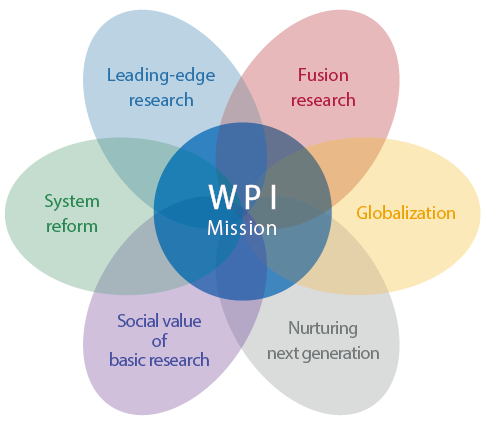
The WPI, which began in 2007, supports the development of “globally visible” research centers that are hosted by various universities in Japan. The main missions of WPI centers are 1. “World-leading scientific excellence and recognition,” 2. “Global Research Environment and System Reform,” and 3. “Values for the Future.”
The first mission is to generate world-class interdisciplinary science, as reflected in research impact and the disciplinary diversity of research teams. The second mission is to create a globalized research environment that drives reform within the host institution, including the presence of foreign researchers and the development of institutional systems that are effective, proactive, and agile. The third mission is to remain future-oriented—both in terms of societal contribution and long-term sustainability—as demonstrated by efforts to show the value of basic research and to ensure the center becomes self-sufficient after the initial WPI funding period. MEXT uses these missions to evaluate each WPI center.
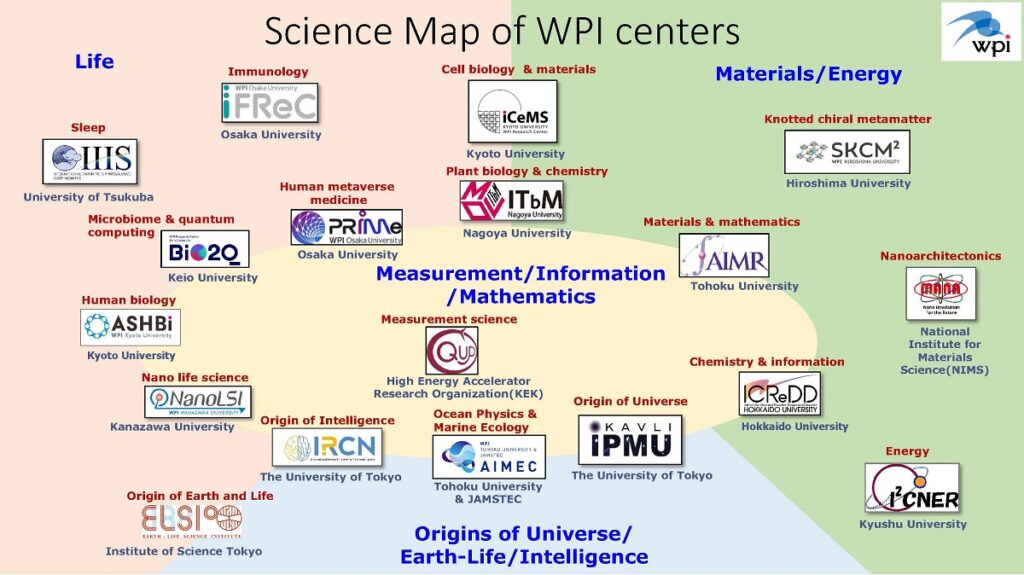
As of 2022, WPI-SKCM2 joins 16 other WPI Centers located throughout Japan. These interdisciplinary centers are grouped into 4 broad research categories: Origins, Life, Materials/Energy, and Measurement.