2026 Nobel Prize in Chemistry Recognizes Pioneering Discoveries in Chirality Research
The 2026 Nobel Prize in Chemistry will honor pioneering discoveries concerning molecular chirality. One of the laureates has strong ties to Hiroshima, making this recognition particularly meaningful to WPI-SKCM², where chirality is an important research theme.
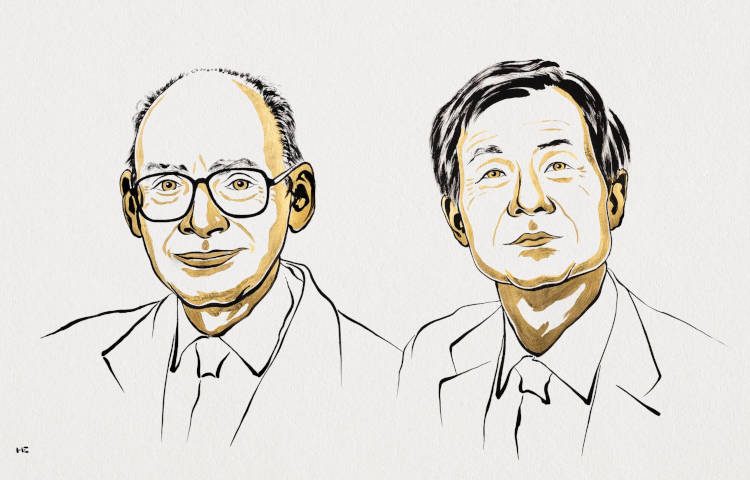
and recipients of the Nobel Prize in Chemistry.
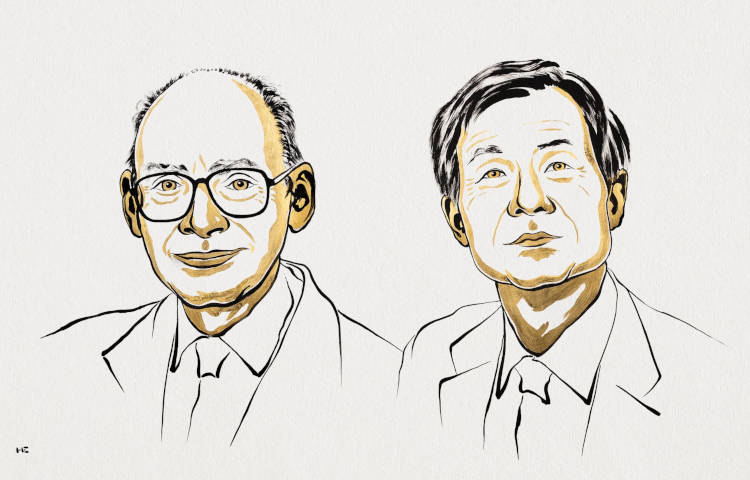
On October 7, the Royal Swedish Academy of Sciences announced that the 2026 Nobel Prize in Chemistry will be awarded to Prof. Kenso Soai, Professor Emeritus at Tokyo University of Science, and Prof. Henri B. Kagan, Professor Emeritus at Université Paris-Sud, France. The prize recognizes their discoveries of “non-linear effects and autocatalysis in asymmetric organic synthesis.” Their work has greatly advanced our understanding of how a small imbalance between mirror-image forms of molecules can be amplified through chemical reactions until one form becomes overwhelmingly dominant.
These discoveries mark an important milestone in chirality research and are closely connected to the scientific mission of the International Institute for Sustainability with Knotted Chiral Meta Matter (WPI-SKCM²) at Hiroshima University.
Understanding Chirality: When Mirror Images Matter
Chirality is a property of objects or molecules that cannot be perfectly superimposed on their mirror images, much like our left and right hands. In chemistry, some molecules exist in two mirror-image forms called enantiomers. These forms can behave differently when interacting with living systems.
One longstanding mystery in chemistry is the origin of homochirality in life. Homochirality refers to the fact that certain groups of molecules in living organisms consist almost entirely of one of two mirror-image forms. For example, nearly all amino acids that make up proteins are of one form, known as the L-form. Why life came to exhibit this preference remains an unsolved question.
Prof. Kagan discovered the “non-linear effect” in asymmetric catalysis, showing that a small imbalance between mirror-image forms in a catalyst can be amplified, producing a larger imbalance in the reaction products. Prof. Soai, meanwhile, discovered an “asymmetric autocatalytic reaction,” in which molecules formed by a reaction themselves act as catalysts that promote the formation of more of the same molecules. Known as the “Soai reaction,” this process demonstrated that a slight imbalance between mirror-image forms can grow as the reaction proceeds, eventually making one form overwhelmingly dominant.
These discoveries offer an important clue to a fundamental question: why are the molecules that make up life predominantly of one mirror-image form? They show that chemical reactions themselves can generate and amplify such an imbalance.
A Scientific Achievement with Connections to Hiroshima
The award also holds special significance for the Hiroshima research community. Prof. Soai was born in Hiroshima Prefecture and graduated from Hiroshima University High School. He has also maintained academic ties with Hiroshima University, including giving a lecture at its Department of Chemistry in December 2009.
The Nobel Prize-winning research is also connected to WPI-SKCM²’s wider academic network. Prof. Tsuneomi Kawasaki, who has collaborated with Prof. Soai on asymmetric autocatalysis and chirality, spoke at an international symposium organized by WPI-SKCM² in Nara in 2024.
Through such connections, longstanding academic exchanges and research networks have developed between Hiroshima’s scientific community and researchers at the forefront of chirality research.
Chirality at the Heart of WPI-SKCM²
The recognition of pioneering work on chirality by the Nobel Prize is especially meaningful to WPI-SKCM², which regards chirality as a central theme linking chemistry, physics, mathematics, and materials science.
While the Nobel Prize-winning research focuses on molecular chirality and asymmetric organic synthesis, WPI-SKCM² takes an interdisciplinary approach that brings together chemistry, physics, mathematics, materials science, and other fields. Its researchers investigate chirality and topology, including structures such as knots, and explore how these features influence the structures, properties, and functions of materials.
The 2026 Nobel Prize in Chemistry once again highlights the fundamental importance of chirality and its potential to inspire new discoveries across a wide range of scientific fields.
WPI-SKCM² extends its heartfelt congratulations to Prof. Kenso Soai and Prof. Henri B. Kagan on receiving this prestigious award.
References
- Japan Science and Technology Agency (JST), Science Portal, October 7, 2026: 2026 Nobel Prize in Chemistry announcement and scientific explanation
- Royal Swedish Academy of Sciences, October 7, 2026: The Nobel Prize in Chemistry 2026