New Communications Physics paper: Liquid crystal skyrmions as elastic multipoles
A team including WPI-SKCM² Visiting Professor Mykola Tasinkevych has published a new paper titled “Liquid crystal skyrmions as elastic multipoles” in Communications Physics.
Chiral liquid crystals enable a large variety of thermodynamically stable topological solitons, which are topologically protected localised distortions of the director field. These solitons exhibit emergent particle-like properties such as mutual interaction, translational motion and reconfigurable self-assembling behaviour in oscillating electric fields.
Despite an extensive body of experimental research, understanding the many-body dynamics of liquid crystal solitons remains a challenge. Existing numerical investigations are limited to a small number of skyrmions and exploit pure relaxational dynamics to track the temporal evolution of the director field.
To address this challenge, first author Allison W. Teixeira and collaborators worked to develop an analytical model capable of addressing out-of-equilibrium collective dynamics of topological solitons in liquid crystals.
Teixeira was the inaugural fellow of the InternKNOTship Program, a research exchange at Hiroshima University that supports collaboration with WPI-SKCM² researchers.
Their model considers only relaxational dynamics of the director in two dimensions and neglects any material flows. For systems with negative dielectric anisotropy, the authors derive analytically elastic multipole potentials, which for symmetric skyrmions are exponentially screened. This corresponds, in an effective way, to the confinement-induced screening of toron interactions in three dimensions.
The model presented may serve as a benchmark for future theoretical developments on solitons’ out-of-equilibrium dynamics, for example by incorporating higher-order elastic multipoles or many-body interactions.
This work contributes to ongoing research at WPI-SKCM² aimed at understanding topological and chiral phenomena across scales and systems.
Paper information:
Title: Liquid crystal skyrmions as elastic multipoles (Communications Physics, 2026)
Authors: Allison W. Teixeira; Cristóvão S. Dias; Mykola Tasinkevych
Link: https://www.nature.com/articles/s42005-025-02400-x
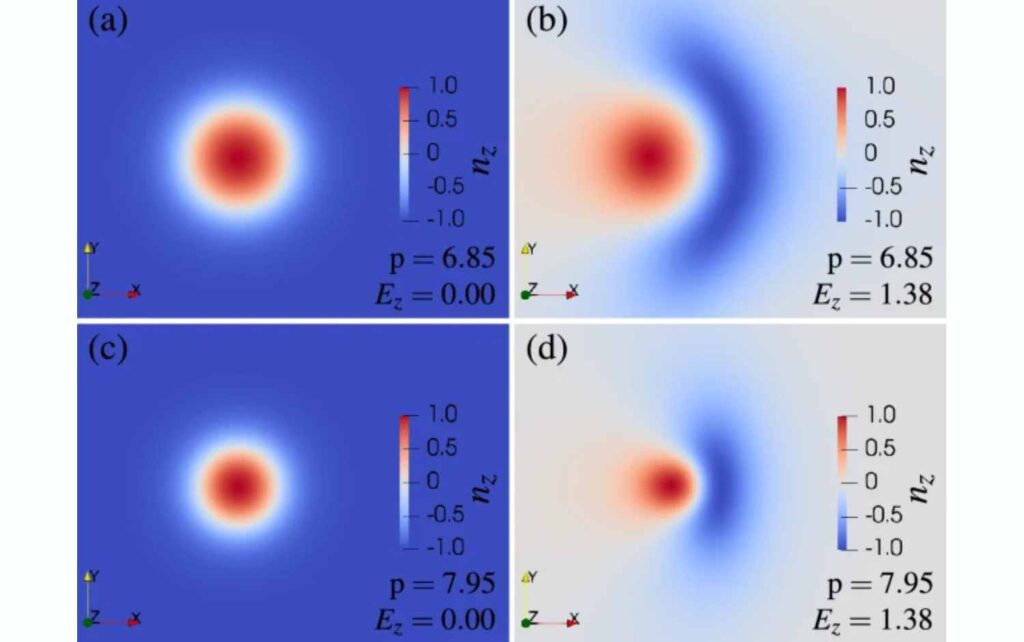
Figure: Equilibrium director configurations for skyrmions and bimerons. © Teixeira et al., Communications Physics (2026)
Other recent and related WPI-SKCM² papers
Manipulating wetting and pore filling by wall transparency (Communications Physics, 2025).
Wetting and capillary phenomena play a pivotal role in numerous physical processes, ranging from water transport in plants and joint tribology to superhydrophobicity and microfluidics. This paper demonstrates using atomically thin walls (transparency) as a tool for manipulating channel filling and wetting behaviors, with potential significance for interfacial phenomena and fluid adsorption in porous materials.
Authors: Svyatoslav Kondrat; Lothar Schimmele; Alberto Giacomello; Mykola Tasinkevych; S. Dietrich.
DOI: 10.1038/s42005-025-02239-2
Liquid crystal torons in Poiseuille-like flows (Scientific Reports, 2025).
Chiral nematic liquid crystals are particularly intriguing due to their ability to host a variety of stable spatially localized topological solitons, including torons, hopfions and skyrmions. In applications such as microfluidics and lab-on-a-chip devices, solitons will interact with material flows, requiring a deep understanding of their behaviour in such environments. This paper extends the theoretical study of liquid crystal torons in Poiseuille-like flows from two-dimensional (2D) to three-dimensional (3D) simulations, addressing key discrepancies observed between previous 2D simulations and the experimental results.
Authors: Guilherme N. C. Amaral; Hanqing Zhao; Mahmoud Sedahmed; Tomás Campante; Ivan I. Smalyukh; Mykola Tasinkevych; Margarida M. Telo da Gama; Rodrigo C. V. Coelho.
DOI: 10.1038/s41598-024-83294-7
Hybridization of colloidal handlebodies with singular defects and topological solitons in chiral liquid crystals (Soft Matter, 2025).
Colloids typically consist of nano-to-micrometer-sized particles suspended in, most commonly, an isotropic continuous medium, such as water. While spherical colloidal particles have been extensively studied due to their simple geometry, abundance, and ease of both preparation and analysis, research on topologically complex particles, such as those with nonzero-genus, remains limited. This study investigates how torons, cholesteric finger loops, and other solitonic structures interact with topologically complex colloidal particles, leading to hybridized particle-soliton configurations, elasticity-mediated interactions, and ensuing bound states, as well as nonreciprocal dynamics yielding translational and rotational motions.
Authors: Jun-Yong Lee; Asha Kumari; Ye Yuan; Mykola Tasinkevych; Ivan I. Smalyukh.
DOI: 10.1039/D5SM00014A