
Members
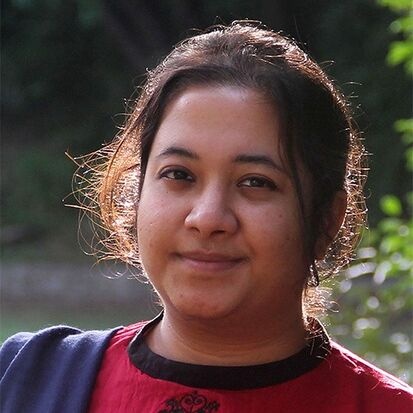
Syeda Rubaiya NASRINPostdoctoral Researcher
(Tate Group)
At SKCM2 I’m investigating how topology and alignment govern stress propagation and failure in cytoskeletal assemblies using liquid crystals.
Affiliations
WPI-SKCM², Hiroshima University
rubaiya_at_hiroshima-u.ac.jp
Bio
Dr. Syeda Rubaiya Nasrin’s research focuses on understanding how mechanical deformation of microtubules, the most rigid cytoskeletal filament, contributes to cellular resilience and adaptability.
At WPI-SKCM2, she investigates microtubules as biological chiral matter, with a particular emphasis on local defect formation, stress response, and emergent collective properties. Her research explores how topology and alignment govern stress propagation and failure in cytoskeletal assemblies using liquid crystal frameworks.
Dr. Nasrin earned her Ph.D. in Chemical Sciences and Engineering from Hokkaido University, Japan, as a MEXT scholar. She subsequently conducted postdoctoral research as a JSPS Postdoctoral Fellow at Kyoto University before joining WPI-SKCM2 in September 2025. She is currently a Principal Investigator of a KAKENHI Early-Career Grant, leading independent research on the physics of cytoskeletal systems.
Mentor :Shinichi Tate
Co-Mentor :Shang-Te Danny Hsu
Co-Mentor : Kyota Yasuda
What I like about my science I enjoy working at the boundary between disciplines. As my professor once said, interdisciplinary researchers are like interpreters, we translate biology for physicists and physics for biologists. I like how my science involves understanding how tiny structures inside cells behave, and how I often describe them using concepts from physics.
Website links
Orcid Research Map Linkedin
Media Coverage & Related Links
Dr. Syeda Rubaiya Nasrin Receives Outstanding Presentation Award at BSJ Chugoku-Shikoku Meeting
Mentor :Shinichi Tate
Co-Mentor :Shang-Te Danny Hsu
Co-Mentor : Kyota Yasuda
What I like about my science I enjoy working at the boundary between disciplines. As my professor once said, interdisciplinary researchers are like interpreters, we translate biology for physicists and physics for biologists. I like how my science involves understanding how tiny structures inside cells behave, and how I often describe them using concepts from physics.
Website links
Orcid Research Map Linkedin
Media Coverage & Related Links
Dr. Syeda Rubaiya Nasrin Receives Outstanding Presentation Award at BSJ Chugoku-Shikoku Meeting