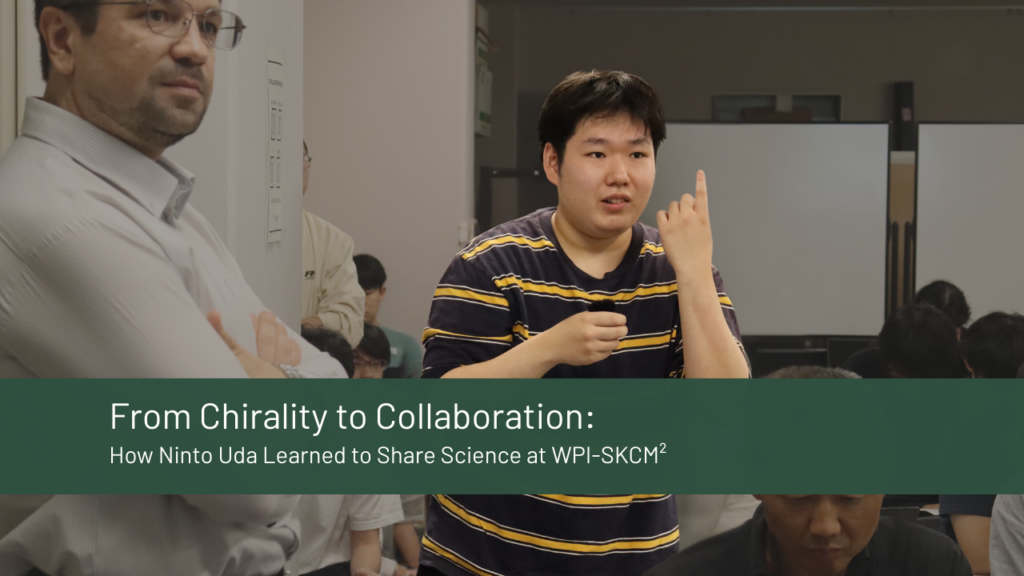
From Chirality to Collaboration: How Ninto Uda Learned to Share Science at WPI-SKCM²
Driven by a strong passion for science and curiosity about chirality, Ninto Uda, a young chemist, chose to begin his graduate journey at the International Institute for Sustainability with Knotted Chiral Meta Matter (WPI-SKCM²) at Hiroshima University. Under the supervision of Professor Katsuya Inoue, Uda has been able to deepen his understanding of chiral materials while steadily refining his research skills.
Beyond advancing his academic knowledge, Uda has also found something unexpected at WPI-SKCM²: a warm, family-like research environment. Surrounded by researchers from diverse disciplines, he has expanded his perspective through daily interactions that extend well beyond his own field.
Endless Learning Opportunities Through Interactive Events
Uda initially joined WPI-SKCM² with the expectation of developing his research primarily through laboratory experiments. However, the institute offered far more than he had anticipated. Through seminars, seasonal schools, and international conferences, he gained frequent opportunities to interact with researchers from a wide range of disciplines—experiences that sparked his growing interest in interdisciplinary collaboration.
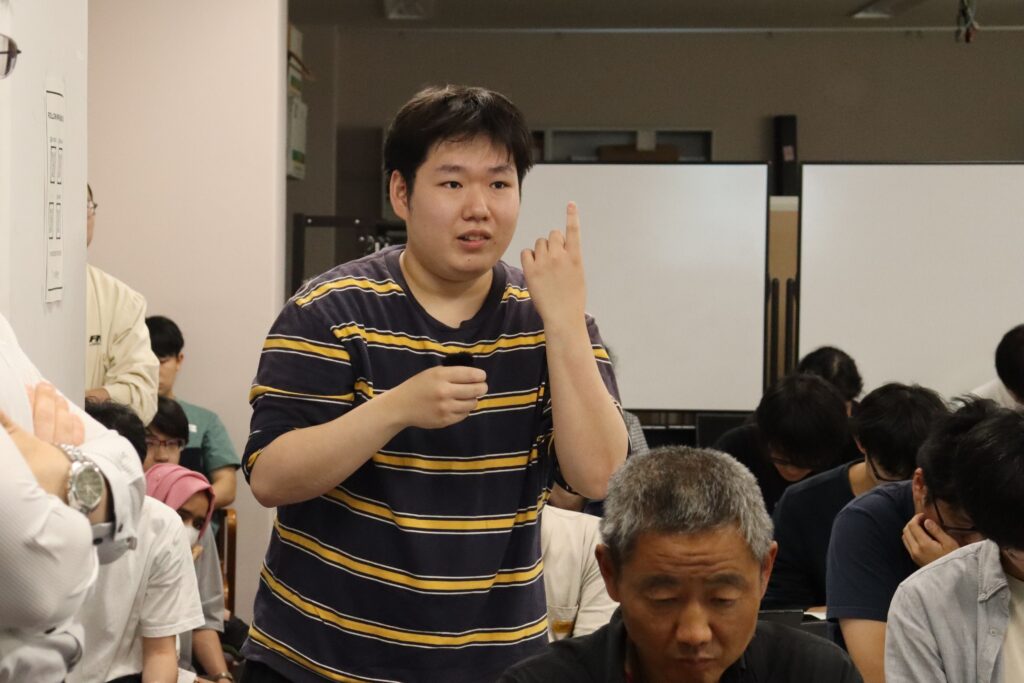
“The key point at SKCM² is that there are people from a variety of fields, and many different seminars are held. From these, you can gain new knowledge, and there are many opportunities for collaborative research,” Uda explains.
In addition, before coming to SKCM², Uda had imagined the world of scientific research as rigid, and professors as distant or intimidating—an image often shared by the general public. To his surprise, he found the atmosphere at SKCM² to be welcoming and supportive. Professors were approachable and encouraging, creating an environment that allowed him to explore his research with confidence and reassurance.
Expanding Worldviews Through Cultural Immersion
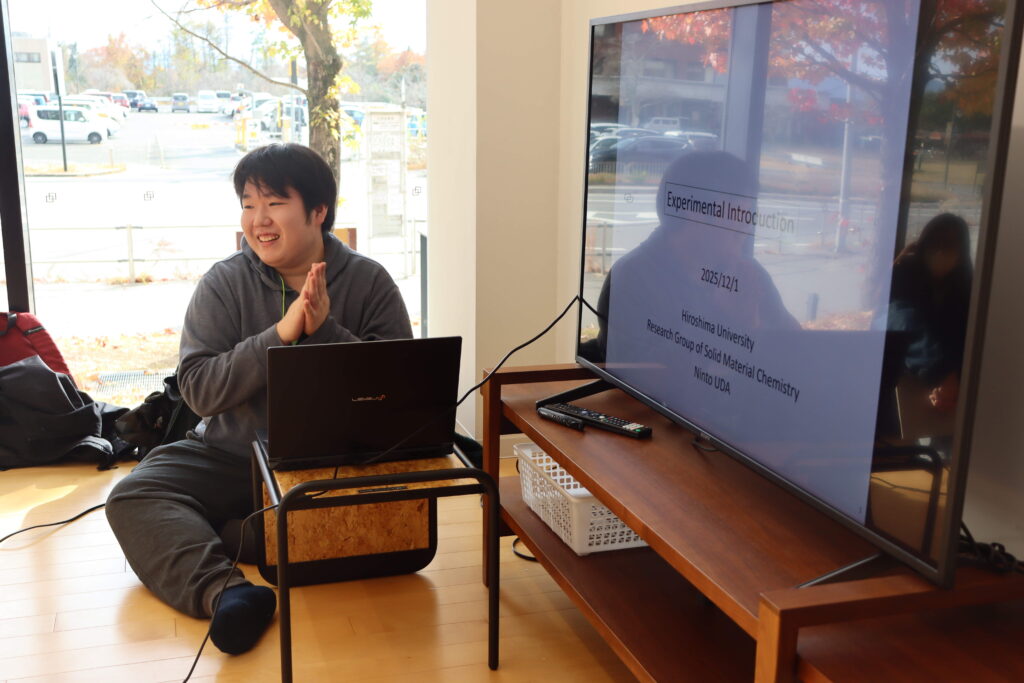
Uda never expected that culture and science could be so closely connected. With a background firmly rooted in science, he had not imagined that learning about people and their cultural backgrounds could influence the way he approaches research. However, the highly international nature of WPI-SKCM² changed that perspective.
“I was able to learn about a variety of fields and meet people doing many different things. When I look at the world more broadly, I think it’s wonderful to be able to see and hear stories from places outside Japan,” he says.
By working alongside researchers from different countries and cultural contexts, Uda began to see how cultural backgrounds shape ways of thinking, problem-solving, and scientific interpretation. This realization encouraged him to reflect more deeply on his own research approach and broaden his intellectual horizons.
Inspired by these experiences, Uda is now eager to continue learning about people as much as science, and hopes to play a role in fostering respect for diversity within the research community.
Learning Interdisciplinarity Through the Fusion Project
Although WPI-SKCM² brings together researchers from diverse fields and countries, opportunities for deep interaction can still be limited when researchers focus primarily on their own work. To address this, the institute actively creates platforms for collaboration—one notable example being the Fusion Project held during the Winter School 2025.
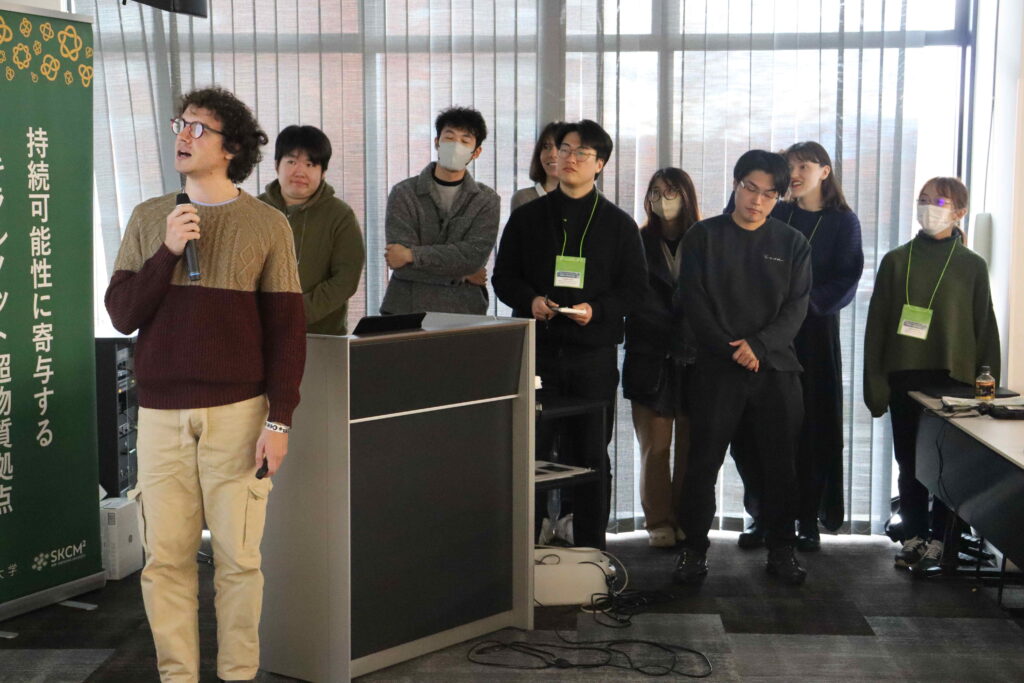
The Fusion Project workshop brought together early-career researchers from different scientific backgrounds and encouraged them to develop a joint research concept that integrated perspectives from multiple disciplines. Uda participated in this workshop and valued the opportunity to connect with researchers beyond his usual collaborations.
He was particularly struck by how differences between disciplines emerged even in simple moments—such as self-introductions or explanations of research topics. While his group successfully developed a fusion research idea that incorporated elements from multiple fields, Uda believes the deeper value lay in learning how each discipline approaches research and knowledge creation.
These insights, he feels, will continue to influence both his academic work and personal growth over the long term.
Looking ahead
“Rather than deciding everything now, I think it’s important to work hard at what you’re doing and increase your options so that more paths become available later,” Uda reflects.
As a first-year master’s student, Uda’s journey is only just beginning, and he does not yet have a fixed vision of his future career. However, his experience at WPI-SKCM² has reshaped how he thinks about career paths. Where he once believed academic trajectories were rigid and predetermined, he now sees how researchers move between fields and careers while continuing to apply their skills and passions.
Instead of rushing to define his future, Uda is focused on fully engaging with his present work. By doing his best now, he believes he can open the door to a wider range of possibilities ahead—an outlook shaped by the interdisciplinary, international, and supportive environment of WPI-SKCM².
If Uda’s journey from curiosity to collaboration at WPI-SKCM² resonates with you, we invite you to take the next step in your own scientific path. WPI-SKCM² is currently accepting applications for graduate admissions, and prospective students who are eager to explore cutting-edge research in sustainable and chiral matter are encouraged to apply by March 31. This is an opportunity to join a vibrant, interdisciplinary community where creativity, collaboration, and curiosity are not only welcomed but celebrated. For more information on the application process and requirements, please visit our Graduate Education Application Process page.
All photos © WPI-SKCM², Hiroshima University.